
The Rural Reality
Rural providers are ready to care for patients — but referral teams often cannot see them.
Rural patients often leave their communities for acute care. When patients are ready for discharge, urban case managers may lack visibility into rural services, available swing beds, and post-acute beds that could safely serve them closer to home. Lack of visibility makes it harder to identify the right local site of care and coordinate repatriation.
If rural care isn’t visible, it isn’t accessed.

Limited Urban-Rural Relationships — non-affiliated rural providers never enter consideration.
Right-Fit Patients Go Elsewhere — patients recover farther away from their communities.
Rural Capacity Sits Idle — available beds and services remain underutilized, weakening the sustainability of rural healthcare.
BedConnect streamlines real-time rural placement.
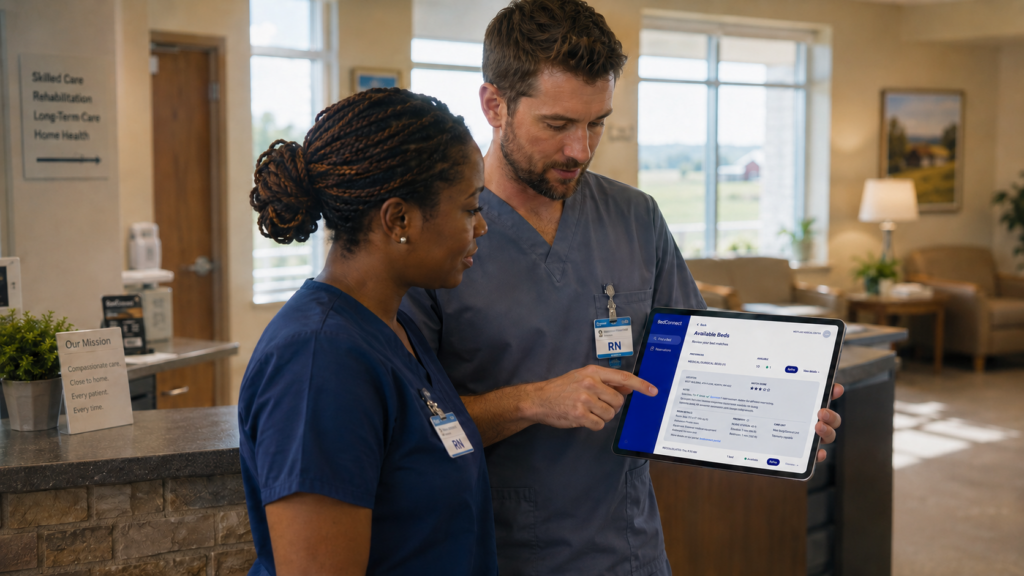
BedConnect® makes rural providers visible to hospitals and post-acute care teams making placement decisions. This gives referral teams a clear path to return appropriate patients closer to home.

Market Visibility — Help urban and regional case managers identify your facility for swing-bed and rural post-acute care.
Clear Repatriation Pathways — Give referral partners an actionable route to return patients to your community.
Right-Fit Referrals — Receive referrals that are an exact match for your services, staffing, payer requirements, location, clinical capabilities, and current availability.
Light-Lift Implementation — Get started quickly without a lengthy IT project or significant operational burden.
Immediate Results, Real Impact

Connect Rural Care Without the Complexity
1
Showcase
Share what you offer — capacity, services, and specialty care.
2
Match
Receive matches that fit your care model and current availability.
3
Accept
Accept matches directly in the platform and streamline intake.
Ready to Bring Patients Closer to Home?
Your community deserves care that stays local. Your facility deserves to be seen by the teams making placement decisions.
Let’s build your rural referral network.
Schedule a DemoFrequently Asked Questions
BedConnect supports Critical Access Hospitals, swing-bed programs, skilled nursing facilities (SNFs), nursing homes, long-term care facilities (LTCs), assisted living facilities (ALFs), inpatient rehabilitation facilities (IRFs), long-term acute care hospitals (LTACHs), home health agencies (HHAs), rehabilitation providers, and other rural post-acute organizations.
BedConnect makes your facility’s availability, services, payer alignment, level of care, and clinical capabilities easier for referral partners to see. This helps urban hospital case management teams identify your organization when a patient from your region may be appropriate for rural placement.
BedConnect creates a clearer pathway for urban hospitals to route appropriate patients back closer to home. By making rural capacity and capabilities visible, BedConnect helps referral teams identify local options instead of defaulting only to familiar urban providers.
Deployment can be achieved in as little as 1 hour. BedConnect is designed to be a light-lift implementation — not a months-long IT project that consumes significant staff or technical bandwidth.
No. BedConnect is intentionally designed to avoid the burden of a traditional enterprise IT deployment. Implementation is fast, lightweight, and built around existing placement workflows.
No. BedConnect does not require EMR integration to get started. EMR integrations are available if desired.
BedConnect is designed to minimize operational lift. In as little as an hour, our initial setup focuses on capturing your facility’s services, capacity, care capabilities, payer alignment, and placement criteria so referral partners can better understand when your organization is a fit.
BedConnect helps make swing-bed capacity and hospital-based skilled nursing capabilities visible to urban hospital case management teams. This supports appropriate repatriation when a patient can receive skilled nursing care in the Critical Access Hospital setting.
BedConnect helps rural skilled nursing facilities (SNFs), nursing homes, assisted living facilities (ALFs), home health agencies (HHAs), rehabilitation providers, and other post-acute organizations showcase capacity, services, payer alignment, and clinical capabilities to regional referral partners.
Your facility can showcase bed availability, service lines, level of care, specialty capabilities, payer alignment, care setting, timing, and other details that help referral partners determine whether your organization is an appropriate placement option.
Yes. BedConnect is designed to support HIPAA-compliant healthcare workflows and patient-choice requirements, with single sign-on (SSO), multifactor authentication (MFA), and enterprise-grade security.
References
- Nelson LF, Harland KK, Shane DM, et al. Against the Current: Back-Transfer as a Mechanism for Rural Regionalization. American Journal of Managed Care. 2017;23(9):e287-e294.
- Elsevier. Article abstract on intentional rural repatriation. The Joint Commission Journal on Quality and Patient Safety. PII: S1553725023001617.
Study findings reflect the populations and care models evaluated in the cited research and may not generalize to every facility or patient population.